Monday, April 3, 2017

Gender and Politics: La Madres De La Plaza De Mayo

The Mothers of Plaza de Mayo; Argentina’s Dirty War
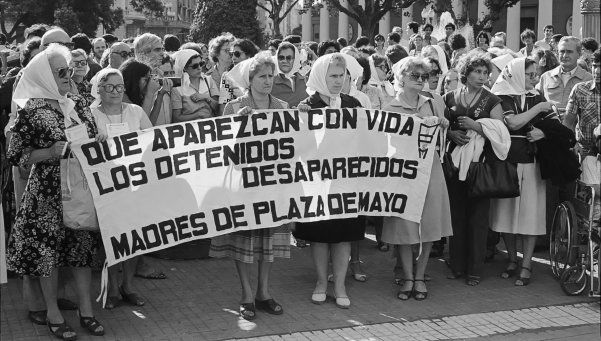
Las Madres Protesting in Plaza de Mayo
         There has been some debate surrounding the Mothers who protest the government in Argentina, demanding answers as to why their children and grandchildren have gone missing. This debate surrounds feminism and how Las Madre’s activism somehow worked against the Latin American feminist movement in the late 1970’s to the early 1980’s. The Dirty War in Argentina isn’t well known to Western society, I have recently only learned about it through three courses I have taken with Dr. Valle-Castro. Since there is such a deep-rooted history between Las Madres and the Argentinean Government I will share the link to a video in which you can watch to inform yourself more about the history of this subject. YouTube on La Madres
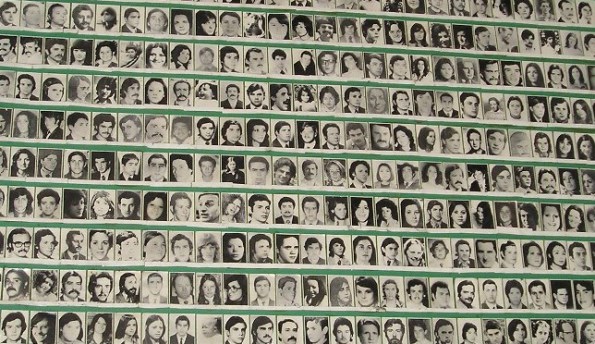
An image of just some of the many missing children from Argentina's Dirty War

To me, the rejection of second wave feminism by Las Madre’s was something I felt they were entitled to as second wave feminism only truly catered to white, middle class women who were told to leave the home, join the workforce and dismantle the patriarchy. Las Madres were making their personal political; they were fighting for answers for their missing children and grandchildren that the Argentine government had stolen from them. Las Madres “rallied around their common identity as mothers [and grandmothers] to bear witness to their experiences and confronted the authoritarian government in the public on moral rather than political grounds” (Fraser 37).

         The Madres put up with harassment, they lived in fear of the Government themselves yet they persevered as a group of women who stood together to fight for what they believed was socially and immorally wrong. It was said that “Las Madres were viewed by many feminists as apolitical beings who were none the less permitted—to an extent—an interest in social issues as an extension of their mothering role” (Howe 44). But the role of a mother is a job within itself and that frame of mind is something that the second wave of feminism failed to accept. It’s no wonder these women rejected feminism; they felt they had no place in the movement. Would you not feel the same? But what the feminist movement failed to acknowledge is that this was a group of women who stood together to protest something they believed (and was) a political issue that the Argentine government was called to address.

         Another interesting political point is that Las Madre's occupied space that the government didn't intervene in. Instead these mothers and grandmothers walked in public, denouncing the Governments actions but were not punished, detained and murdered for their actions. However, if they were not a group of madre's or grandmothers would they have had the same security? Their children were protesting against the Argentine government and were deemed "terrorists and subversives" (Fraser 37)
The Argentinan Government forcefully detaining what they described as a "terrorist".
but instead the “government
focused on diminishing the legitimacy of Las Madre's; having the press refer to these women as the Locas de la Plaza de Mayo (meaning the crazy mothers)” (Fraser 37). How ironic, women who protest the government by acting and taking a stand against it are labeled as crazy. It's no surprise that the Argentine government would use terminology such as that to undermine this movement. After all; women are dismissed as hysterical and delusional in society today when we speak up against what we feel is morally and politically defective. But back to the question of security, the Madre's had control for the simple fact that they were, indeed, mothers. “Their very presence was a statement of security, as women did not traditionally have a role in politics” (Fraser 37) so the fact that these women, mothers at that, formed a group that protested the governments actions shows that “success in overcoming the silence and opening a public discourse while raising national and international support for their cause shows that entrenched enemy images can be overcome” (Fraser 38). As they say, there is power in numbers and when the personal becomes political and is inclusive and intersectional women's voices cannot be dismissed.

Now, to tackle the issue of Trump! 
You've got to be kidding me...


Works Cited

Fraser, H M. “"Los Desaparecidos": The Madres of the Plaza de Mayo and the Reframing of the Victims.” Canadian Woman Studies, vol. 27, no. 1, 2009, pp. 36–39. Proquest, Accessed 18 Feb. 2017. 

Howe, Sara E. “The Madres de la PLaza de Mayo: asserting motherhood; rejecting feminism?” Journal of International Women's Studies, vol. 7, no. 3, Mar. 2006, pp. 43–50., Accessed 18 Feb. 2017.

We Aren’t Representing Older LGBT+ Adults

I came out when I was relatively young, and that is the narrative I see. I see coming out stories that are close to mine. I see media about young folks I can relate to, and many resources I have access to revolve around folks who are loud about their identities. Although it is not a negative thing to be be loud and proud, and young folk’s voices are not always listened to, but it may be time to shift the spot-light.
SAGE Logo
Terms
  • Coming out: Someone’s personal experience when telling themselves, family, or friends about their LGBT+ identity.
  • Transgender: A person who does not identify as the gender they were socialized as (ex. A transgender woman would be someone who was socialized as a man but identifies as a woman).
  •  Older adult: The preferred term over ‘senior’.
  •  LGBT+: An acronym that stands for lesbian, gay, bisexual, and transgender (and more).
Patricia Davies of Leicestershire, England
 “I was 60 when it all came pouring out to my wife, she was very sympathetic and helped me all the way but we agreed to keep it quiet,” Davies said, “She used to buy me jewelry and she would call me Patricia. I kept it a complete secret".
This narrative was one I was extremely unfamiliar with. Being too young to marry or have children of my own yet, I have never experienced having to come out on that level.

I had rarely given thought as to how Pride events exclude older adults. I knew how they were usually 19+, which left out youth, but was unaware of how Pride events were rarely inclusive of older LGBT adults. 
Saskatoon Pride Festival 2016 did not offer any LGBT+ events that specifically targeted older adults. Events that were purposefully quieter and targeted both older adults who were out, and those who were not. The closest event might have been a bingo night, but it was a dirty (or as saskatoonpride.ca described it: “alternative mind”) and the prizes involved alcohol (which would make many uncomfortable, since many LGBT+ individuals struggle with alcohol dependencies.

 In an article by Tina Donivan, a 61 year old transgender woman, she explains how organizations have given her support to help her in becoming sober and find friends, and become a role model. “I have worried about growing older alone. I have been concerned that should I remain single, I will not have a caregiver. My experience of losing friends and lovers has shrunk my ability to make new friends and feel part of a community. However, the organizations that I belong to put me in touch with other organizations that serve different needs. As a result, my isolation has decreased and my fears about getting older alone have lessened”.
  

I am still fairly young, so I cannot speak to the lived experiences of older adults who have come out, but I can speak to the little to no representation I see around LGBT+ older adults.  
A recent interview with WWII veteran (2017), Patricia Davies, grew extremely popular and was talked about by many in the community, but it shed a light on an issue that many have been quiet on, where are all the LGBT+ older adults? They obviously exist, the problem is, is that organizations are not giving them the proper space and resources, and media outlets are not giving them proper representation.


 Davies is a 90 year old transgender woman, and describers her experience of being closeted for years and knowing she was a woman but not having a term for how she felt.

 Another narrative by Christina Comeau, a 60 year old transgender woman, spoke to the fear surrounding coming out for older adults, and the difficulty and risks faced. 

"It's terrifying to come out in that context people have built an entire life for themselves embedded in communities and jobs and often family 
where they might have kept these feelings quite secret". 


It is extremely important to focus on everyone in the LGBT+ community, giving them adequate resources, space, and representation, regardless of age. For older adults this could mean organizations offering events that are alcohol free and quieter, so adults that are not out can have space to be themselves and feel safe.


Gender in Science

              As a student of nursing my focus is on western medical science.  We are taught about evidence based practice where to justify our actions (or inaction) high quality research should inform.  There is even a hierarchy of what is considered good evidence.  The evidence pyramid shows that as you move up, the amount of evidence lessens but the accuracy increases.

Many high-quality studies use double blind randomized controlled variables and in health care gender variables are always at the forefront in considering study designs.  As I am learning gender is not simply binary in terms of male and female but can be fluid, fixed, or can change from one identity to another.  Joan Scotts’ article “Gender: A Useful Category of Historical Analysis”, opened my eyes on how we categorize gender (1986).  I feel it important to clarify her definition of gender:

What is Gender?

Scott defines gender having two parts and several subsets:
1.       Gender is a constitutive element of social relationships based on the perceived differences between male and female.
2.       Gender is a primary way of signifying relationships of power.
a.       Culturally available symbols – mother earth, phallus, etc
b.       Normative concepts that try to limit these symbols.
c.       Kinship, economics, and politics influence ideas of gender
d.       Subjective identity – how one sees themselves


My understanding of her concept of gender is that it is contextual, informed by societal norms, and simply cannot be categorized as male or female.  I am not totally ignorant that gender identity is complex as I am aware of categories propagated by media in terms of the LGBTQ community.  Delving into a category of my own, which is simply male, I begin to question what this means.  Have I succumbed to the social and stereotypical norm of masculine male that I have restricted my introspection to only include what is “acceptable” to be a man?  Personally, Scotts definition has opened my eyes on what defines me.  Is it the outside telling me who to be, or is it truly what is inside that is being evoked. 

Going back to the issue of gender when it comes to scientific enquiry I now rethink what this can do for future study.  Interestingly, the European Union commissioned an inquiry into this issue titled Gender in Research (European Commission, 2001).  Although dated, it put forth some compelling arguments as to the future study considering gendered issues.  As Western sciences have a masculine character, gender stereotypes dominate scientific discourse, and this gender bias is shaping the scientific agenda which also is male dominated(European Commission, 2001). According to Schiebinger (1999), sustainable science needs to be pragmatic in that it considers goals and outcomes from a gendered perspective. It also requires the recognition of socio-economic elements to provide entry-points for the identification of gender impacts.  This gives me hope that as we change and learn more on gendered inequities, science is slowly trying to identify ways to accommodate.

In Canada, there is a program called Gender-Based Analysis Plus (GBA+) that allows people to report on policies, programs, initiatives or services that you feel are impacting gendered groups.  They do admit that the service is underused and are looking for improvements.

As I continue with my education and seek to provide evidenced based practice I will continue to critique and look for gender appropriate information.


References

European Commission (2001). Gender in Research, retrieved from: http://ec.europa.eu/research/pdf/gender-in-research-synthesis-report_en.pdf

Schiebinger, L. (1999) Has feminism changed science? Cambridge: Harvard University Press +
12, 201-206.

Scott, J. (1986) Gender: A Useful Category of Historical Analysis. The American Historical Review 91(5) 1053-1075.